
After years of digital transformation initiatives, 2026 is shaping up to be less about technological experimentation and more about behavioural reality. Across insurance markets globally, customer expectations are evolving at pace, reshaped by mobile-first lifestyles, instant digital services and growing intolerance for friction.
For insurers, MGAs and InsurTechs, the challenge is no longer simply adopting new tools. It is responding to a customer base that expects immediacy, personalisation and simplicity by default.
This is underlined by recent research from Zipdo, which found that in 2025, 80% of insurance customers expect real-time updates and communication from their providers, while 75% are more likely to purchase from insurers that offer personalised experiences.
In conversations with FinTech Global, leaders across the InsurTech ecosystem outlined how these changing expectations are set to redefine engagement models, operational design and commercial strategy in the year ahead.
The age of micro engagement
For Simha Sadasiva, Co-founder and CEO at Ushur, the starting point is attention.
“We are moving towards a world where people’s attention span is even more dwindling,” he said.
More than a decade ago, Ushur coined the term “micro engagement” to describe a growing preference for short, bite-sized interactions over lengthy communications. That hypothesis, he argues, has become reality.
“If I were to send you a long piece of information, you have less appetite and less intent to consume that. But if I send you a small blurb, you are more likely to consume it.”
In practical terms, this means insurers can no longer rely on long forms, complex documentation or multi-step processes that demand sustained attention. Customers expect quick, contextual exchanges delivered via the channel of their choosing, whether SMS, app, chat or voice.
As digital noise increases, insurers that master these micro interactions are more likely to capture and retain engagement.
Real-time as the new baseline
Ido Deutsch, Chief Revenue Officer at Producerflow, sees the same dynamic playing out across both consumer and enterprise interactions.
“Both on the consumer side and on the business side that consumes our solutions, everyone expects real-time experiences,” he said.
Onboarding new agents, integrating vendors and activating new systems are processes that were once measured in weeks or months. They are now judged against the standard set by e-commerce and fintech platforms.
The implication is structural. Insurers must compress timelines and eliminate friction not just in customer journeys, but across their partner ecosystems.
Deutsch noted that this shift is also reshaping how carriers evaluate technology investments. Rather than implementing solutions for innovation’s sake, they are asking more disciplined questions.
“What is this solution going to help me with? How do I measure this in terms of revenue that comes back at the end?”
As expectations rise, speed and measurable outcomes become intertwined. Delivering real fast experiences that solve solutions in real time is no longer aspirational. It is becoming table stakes.
Insurance as a push product and the pricing challenge
Yasser Rajwani, Product Manager at Earnix, argues that evolving expectations are particularly complex in insurance because it remains fundamentally a push product.
Consumers rarely wake up intending to buy cover. Engagement is typically triggered by life events, regulation or marketing prompts. That makes value perception critical.
Insurers, he suggests, must set expectations clearly through sharper pricing, streamlined processes and greater transparency.
“If you are using machine learning and AI not just in your marketing but also in the core insurance processes,” he said, “from underwriting to claim settlement to renewal, each and every step can be made easier and more efficient.”
Improved operational precision feeds directly into customer experience. Faster claims settlement, more accurate pricing and smoother renewals reduce friction and increase trust, often more effectively than front-end marketing campaigns alone.
Rajwani emphasised that meeting higher expectations requires unified, end-to-end processes that provide governance and control. Fragmented systems risk undermining the simplicity customers demand.
Mobile-first markets and generational shifts
Peter Ohnemus, President and CEO at dacadoo, placed these behavioural shifts within a broader generational and geographic context.
“In Asia, people live on their smartphones,” he said. “They are not going to have someone knock on the door with a brown leather bag selling a life policy.”
For Ohnemus, the shift is structural rather than cyclical. Industries such as travel, retail and banking have already undergone digital disruption, and insurance is now facing similar pressure as customer behaviour evolves.
He pointed to the surge in digital health and insurance-related queries across platforms such as OpenAI’s ChatGPT as evidence that consumers increasingly expect immediate, accessible information.
“We have never seen that before,” he said, describing life and health insurance as emerging power users in the generative AI ecosystem.
For life and health carriers in particular, this represents both an opportunity and a warning. Customer expectations are being shaped outside the traditional insurance ecosystem, and insurers must adapt accordingly.
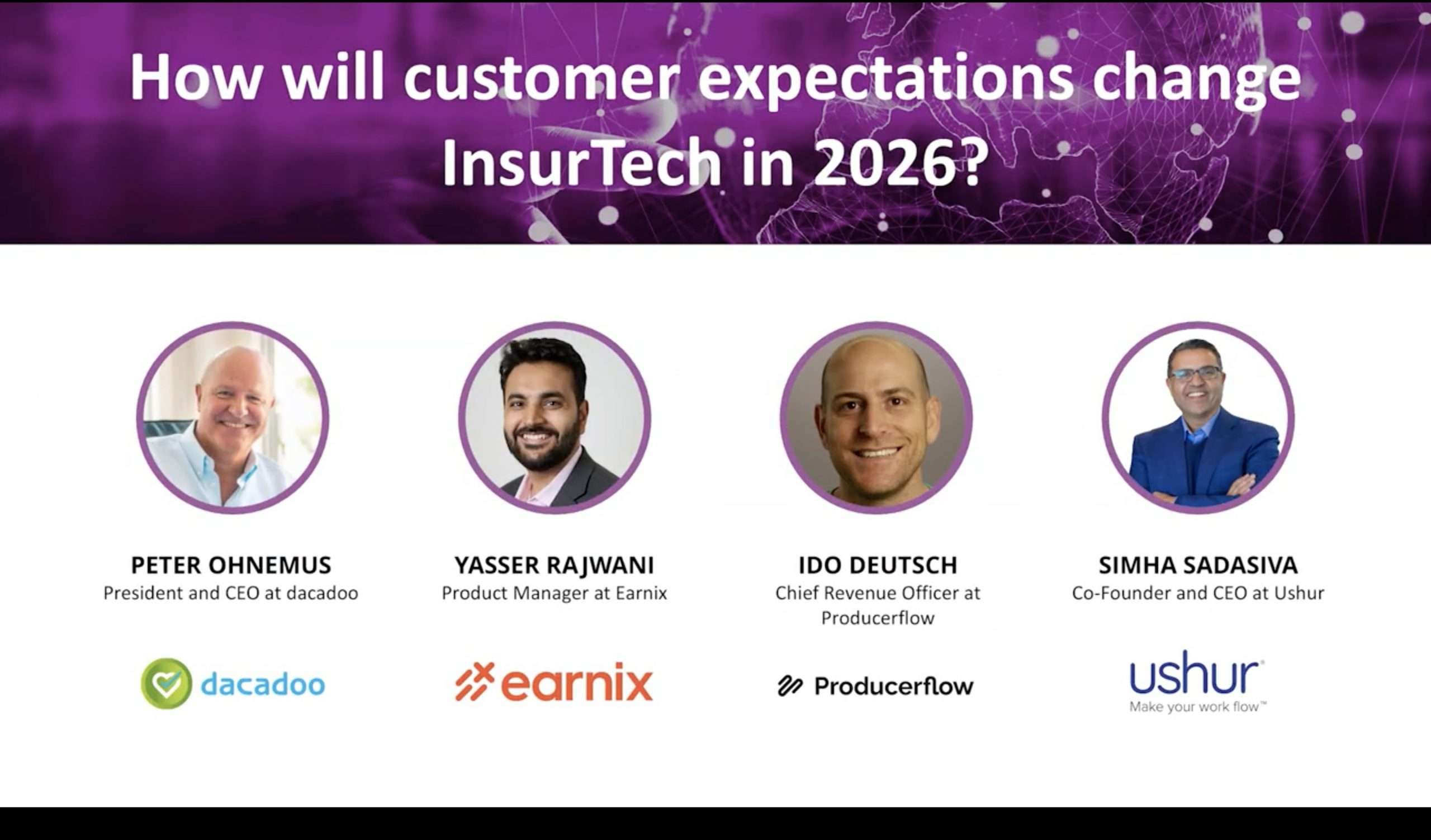
During this interview, Simha Sadasiva, Co-founder and CEO at Ushur, Ido Deutsch, Chief Revenue Officer at Producerflow, Yasser Rajwani, Product Manager at Earnix, and Peter Ohnemus, President and CEO at dacadoo, discussed:
- How shrinking attention spans are driving the rise of micro engagement in insurance
- Why real-time experiences are becoming the baseline expectation across consumers, agents and enterprise partners
- The growing importance of measurable ROI in InsurTech implementation decisions
- How pricing precision and operational efficiency shape customer perception in a “push product” market
- The shift toward mobile-first engagement models, particularly in Asia
- Why evolving customer expectations, not technology alone, will define InsurTech in 2026
Find the full video below.
Keep up with all the latest FinTech news here
Copyright © 2026 FinTech Global

