
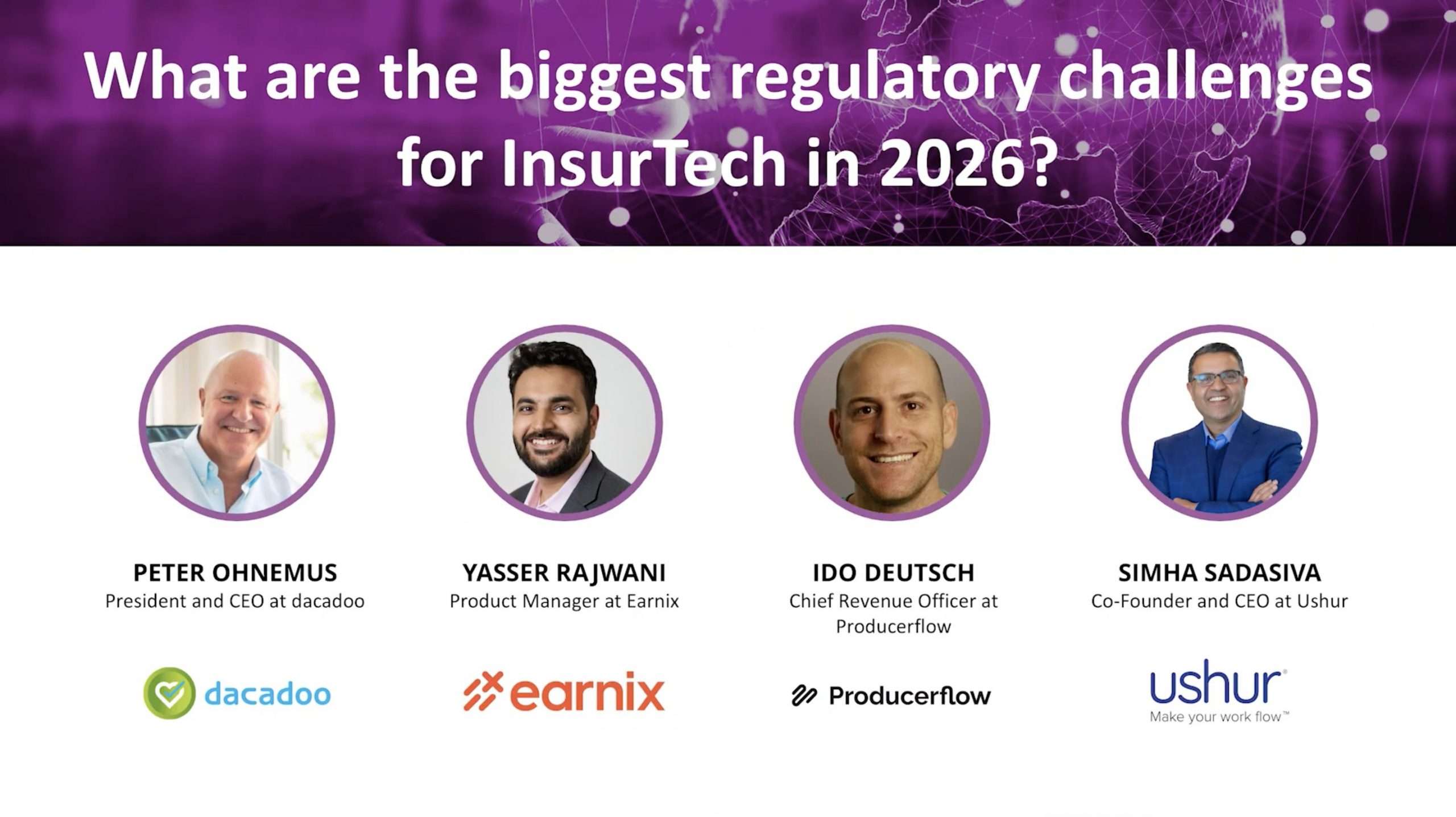
As the InsurTech sector matures, regulatory pressure is no longer a secondary consideration. In 2026, compliance, transparency and capital discipline are emerging as defining forces shaping innovation across the sector.
In conversations with FinTech Global, leaders across the InsurTech ecosystem outlined the governance, compliance and capital challenges that will define the year ahead.
Engineering trust into the technology stack
For Simha Sadasiva, Co-founder and CEO at Ushur, regulatory readiness must be built into the architecture itself.
“Compliance, data privacy and how you underwrite risk and interact with customers are all key governance pillars in insurance,” he said.
Sadasiva believes the burden cannot sit solely with compliance teams. Instead, guardrails must be embedded directly into the technology stack. That includes deterministic risk prediction models, clear audit trails showing how decisions were made and robust fallback mechanisms that keep a human in the loop when needed.
“If you don’t think about solving each piece of the problem from the perspective of governance, risk, compliance and trust, you can’t engineer the right solutions,” he explained.
For regulated industries, verifiability and auditability are not optional features. They are differentiators. Demonstrating that systems are trustworthy, traceable and controllable has become central to winning enterprise clients in an environment where regulatory scrutiny is intensifying.
AI governance and the transparency imperative
Ido Deutsch, Chief Revenue Officer at Producerflow, sees AI governance as one of the most immediate regulatory pressure points.
“With AI, there is a lot of governance required around data privacy, managing models and understanding risk,” he said. “Many of these models are almost like black boxes.”
That opacity presents a challenge for insurers operating in tightly regulated markets. Deutsch argues that auditability must become simpler and more robust, with clear transparency around how automated decisions are made.
There will also need to be human oversight.
“Humans will have to be in all those processes, maybe fewer humans, but doing different things,” he said.
He expects a hybrid model to emerge. Regulated decisions will require traceability, transparency and human validation, while large portions of backend processes become automated. In his view, automation and compliance are not opposing forces, but must be carefully balanced.
Solvency, IFRS 17 and capital pressure
Yasser Rajwani, Product Manager at Earnix, points to capital regulation rather than technology as the biggest structural challenge facing insurers.
He highlighted solvency requirements and IFRS 17 as areas where regulation has struggled to keep pace with technological capability.
The modern insurance environment allows for far more granular pricing and risk modelling than when many frameworks were conceived. Insurers can now price at an individual policyholder level and value risk with greater precision. Yet regulatory prudence margins and capital requirements have not always adjusted in line with these advancements.
In a high interest rate environment, capital efficiency becomes critical. Holding excess capital limits reinvestment flexibility and constrains growth.
“Most insurers want to get their capital requirement down to the last decimal,” Rajwani noted, reflecting industry pressure to optimise solvency positions without compromising regulatory compliance.
The tension lies in balancing innovation-driven precision with legacy prudential frameworks designed for less dynamic risk modelling environments.
The legal framework for generative AI
Peter Ohnemus, President and CEO at dacadoo, believes the regulatory debate must extend beyond compliance checklists and into ethical guardrails.
“I’ve always been a big believer in data privacy,” he said. “In the AI space, we need empathy.”
Ohnemus described generative AI as the most powerful innovation he has witnessed in more than three decades in software. Its pace of development, however, has left regulators struggling to respond.
“The problem is that regulators are a bit overwhelmed, because everything moves so fast,” he said.
For life and health insurers in particular, where decisions can materially affect customer wellbeing, he argues that explainability is essential. Insurers must be able to document what their generative models are doing, why recommendations are made and how outputs are derived.
He advocates for clear legal frameworks and structured oversight. “If we play football together and we have clear rules, we have more fun and become more successful,” he said. “If it’s anarchy and no rules, it becomes dangerous.”
In his view, insurance companies favour structure and seriousness. The so-called “wild west” approach to AI experimentation has little place in a sector built on long-term trust.
Across the full interview, the InsurTech leaders discussed:
- Embedding governance, audit trails and human oversight directly into core systems
- Strengthening AI transparency and model explainability in regulated decision-making
- Navigating solvency frameworks and IFRS 17 in a more dynamic pricing environment
- Balancing capital efficiency with prudential requirements
- Establishing legal and ethical guardrails for generative AI in life and health insurance
Copyright © 2026 FinTech Global

