
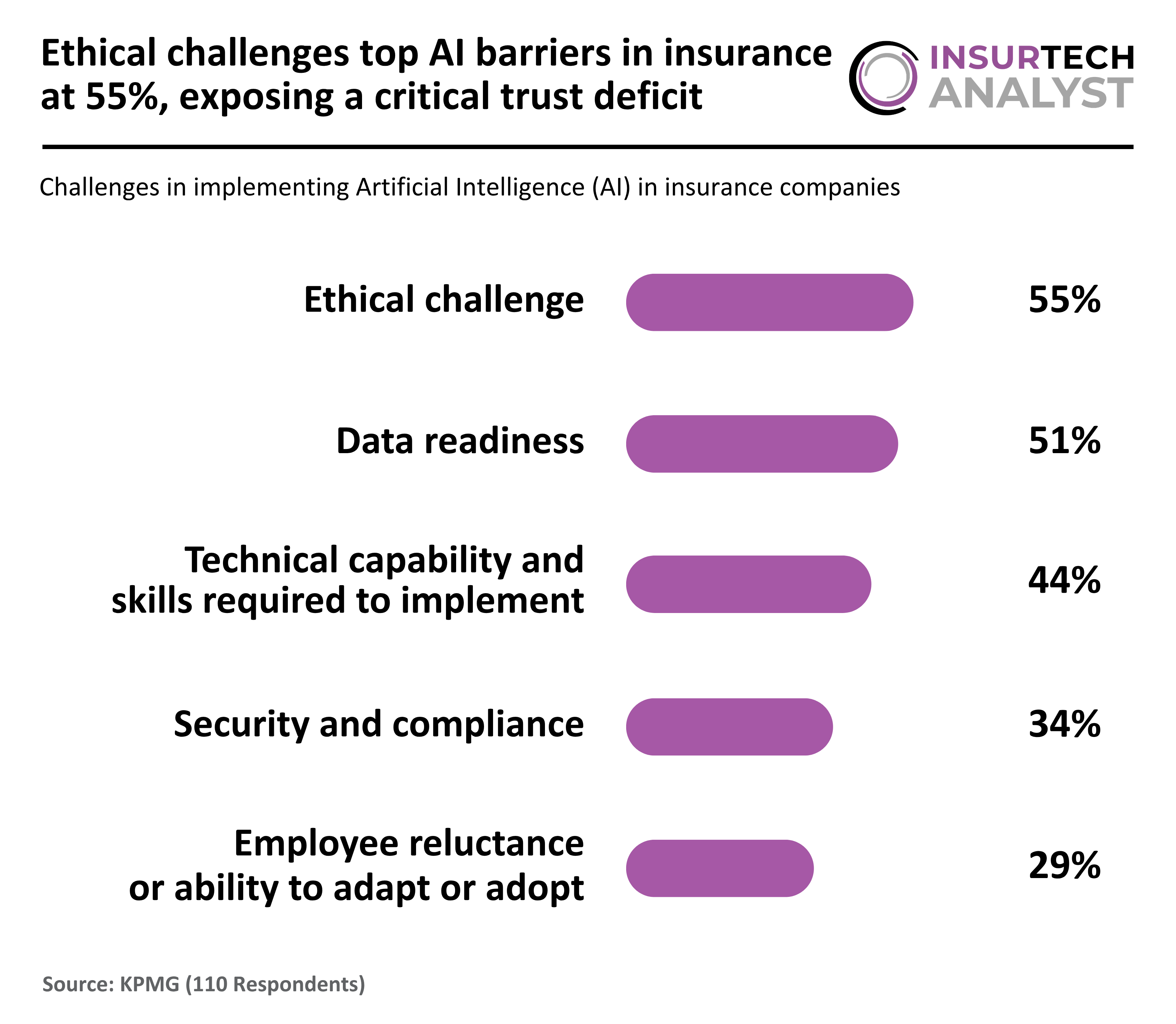
Key views of challenges in implementing AI in insurance companies:
- KPMG’s Insurance CEO Outlook surveyed 110 insurance CEOs across 11 markets on the key challenges they face in implementing AI
- Ethical challenges top the list at 55%, ahead of data readiness at 51% and technical capability at 44%
- The data points to a trust problem at the heart of AI adoption, where governance and transparency matter as much as technology
KPMG’s Insurance CEO Outlook surveyed 110 insurance CEOs across 11 markets on the key challenges they face in implementing AI
The findings come from KPMG’s Insurance CEO Outlook, a study focused exclusively on 110 senior insurance leaders drawn from life, auto, home, property and casualty, health, reinsurance and broker organisations.
Every respondent leads a company with annual revenues above $500m, and a third lead businesses generating more than $10bn.
The study reaches across 11 markets, from the UK and US to Japan, China and India, capturing a genuinely global perspective on the strategic challenges facing the sector.
One of the questions explored was what CEOs regard as the principal obstacles to implementing AI within their organisations.
Ethical challenges top the list at 55%, ahead of data readiness at 51% and technical capability at 44%
The results highlight a set of concerns that span technology, governance and culture. Multiple responses were permitted.
Ethical challenges ranked as the most cited obstacle, identified by 55% of respondents.
Data readiness followed at 51%, with technical capability and the skills required to implement AI cited by 44%.
Security and compliance were identified by 34% of CEOs, while employee reluctance or ability to adapt and adopt rounded out the findings at 29%.
The data points to a trust problem at the heart of AI adoption, where governance and transparency matter as much as technology
What the data collectively reveals is that the barriers to AI implementation in insurance are not primarily technical.
The fact that ethical challenges rank above data readiness and skills gaps points to a deeper anxiety about how AI will be perceived by customers and regulators alike.
Insurers already face a trust deficit with policyholders, and the introduction of algorithms into claims assessment or pricing decisions risks deepening that gap if not handled carefully.
Data readiness and technical capability are problems that can be solved with investment and time.
Trust is harder to rebuild once lost.
The priority for insurance CEOs is not simply to implement AI effectively but to do so in a way that is transparent, fair and defensible, both to customers and to the regulators who will increasingly scrutinise how these systems are deployed.
Keep up with all the latest InsurTech news here
Copyright © 2026 InsurTech Analyst





